
Consumer Guide: What’s Really Inside Your Cranberry Product?
A transparent guide to frozen, dried, sauced and juice-based cranberry products

Cranberries, in many forms
Fresh cranberries are naturally tart and harvested during a relatively short season, generally during the fall in North America. Processing allows cranberries to be enjoyed year-round, transported to markets where fresh cranberries may not be readily available and used conveniently in drinks, sauces, baked goods, snacks and everyday meals.
“Processed,” however, can mean many different things. Cranberries may simply be frozen, or they may be dried, cooked, pressed, concentrated or blended with other ingredients. Each process gives the fruit a different flavor, texture, shelf life and nutrition profile.

Are the additional ingredients safe?
Ingredients such as sugar, high-fructose corn syrup (HFCS), non-sugar sweeteners, acidity regulators, stabilizers and preservatives may sound highly technical, but each serves a specific function in the finished product.
Food manufacturers are legally required to comply with the food-safety regulations of every country in which their products are sold. Relevant national or regional authorities assess and authorize food additives and establish the conditions under which they may be used, including permitted food categories, maximum usage levels and labeling requirements. Manufacturers are responsible for ensuring that their ingredients and finished products meet all applicable requirements.
Regulatory authorization applies to a particular ingredient used for an approved purpose and under specified conditions—it does not imply that unlimited consumption is advisable. Consumers may still choose products according to their nutritional needs and preferences, including the added sugar, calorie and juice content.
CLOSEST TO THE FRESH FRUIT
Frozen cranberries
Fresh cranberries are cleaned, sorted and rapidly frozen, often soon after harvesting. Some are individually quick-frozen so that the berries remain separate rather than freezing into a solid block.
Freezing at very low temperatures slows the chemical and microbial activity that causes food to deteriorate. Properly stored frozen cranberries can retain good quality and many of the health benefits for approximately one year.
They can be used directly from the freezer in sauces, smoothies and cooked dishes. They may also be used in baked goods, although thawing can soften their texture because ice crystals disrupt some of the fruit’s cellular structure.
What processing changes
Freezing generally causes relatively modest nutritional changes. The texture may become softer after thawing, but much of the fruit’s fiber and polyphenol content remains.

Unsweetened frozen cranberries generally do not require added sugar, preservatives or color. Check whether the berries are sold alone or as part of a sweetened fruit mixture.
CONCENTRATED AND CONVENIENT
Dried cranberries
What processing changes
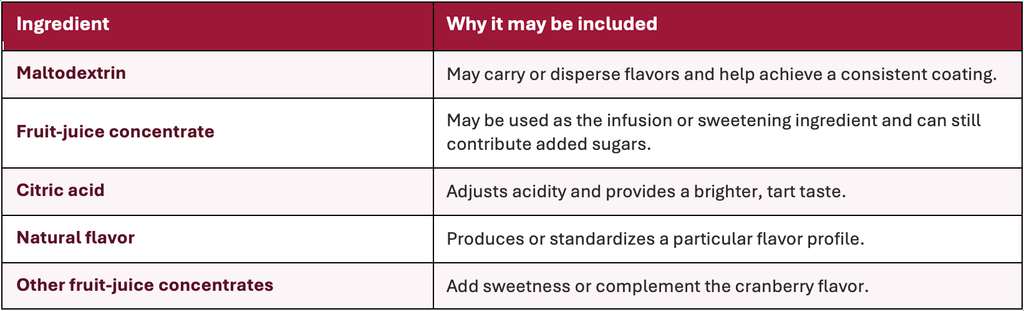
Drying and heating can reduce some heat-sensitive nutrients and alter the amount or availability of certain polyphenols. However, dried cranberries retain fiber and cranberry polyphenols and provide a convenient way to add fruit flavor, color and texture to breakfast cereals, oats, trail mixes, salads, baked goods and cooked dishes.

Possible ingredients and their functions
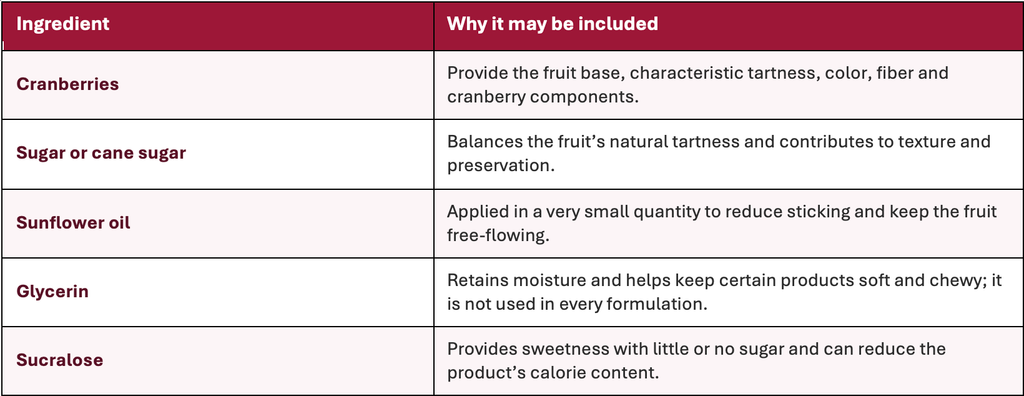
Juice-infused or flavored varieties may also contain
COOKED, THICKENED AND SERVED AS A CONDIMENT
Cranberry sauce
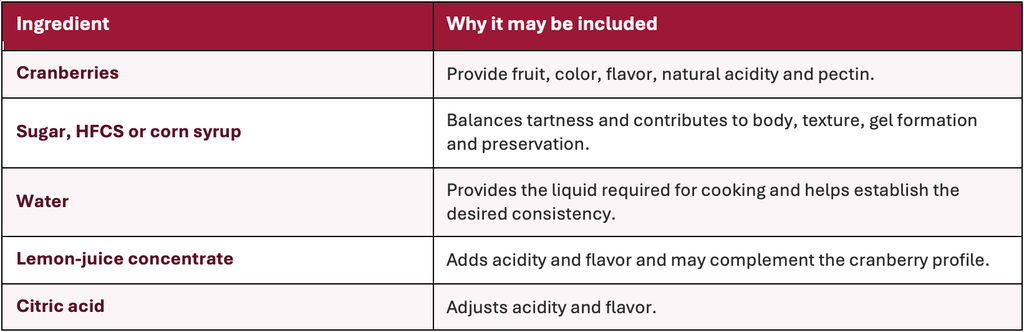
Cranberry sauce is made by cooking cranberries with water and a sweetener. Cranberries naturally contain pectin, which helps the sauce thicken as it cooks and cools. Commercial products include whole-berry sauces and smooth, jellied sauces. Formulations may contain additional ingredients to achieve a consistent sweetness, texture, appearance and shelf life.
What processing changes
Heating can reduce some heat-sensitive nutrients and may alter the amount or availability of certain cranberry polyphenols. The finished sauce retains cranberry fruit components, but its nutritional composition differs from that of fresh or frozen cranberries, particularly when sweeteners are added.

Possible ingredients and their functions
What is high-fructose corn syrup (HFCS)?
HFCS is a liquid sweetener made from corn and used in some foods and beverages to provide sweetness. Despite its name, the most common form of HFCS contains approximately 55% fructose and 45% glucose—similar to table sugar, which contains 50% fructose and 50% glucose. HFCS is considered an added sugar and, like all added sugars, should be consumed in moderation.
Learn more about HFCS from the International Food Information Council (IFIC).
THE PRODUCT NAME MATTERS
Cranberry juice and beverages

100% cranberry juice
Pure cranberry juice is made from cranberry juice or from cranberry juice concentrate that has been reconstituted with water. It has an intensely tart taste and may be consumed in smaller quantities or used as an ingredient in other drinks.
Juicing removes most of the whole fruit’s insoluble fiber and cellular structure. Cranberry polyphenols remain in the juice, although their types and amounts can vary according to the fruit, processing method and serving size.


100% juice blend
A 100% juice blend contains only fruit juices but may combine cranberry juice with naturally sweeter juices such as apple, grape or pear juice.
The statement “100% juice” does not necessarily mean “100% cranberry juice.” Read the product name and ingredient list to identify the other juices used. These blends can contain substantial naturally occurring sugar even when no separate sugar or syrup has been added.
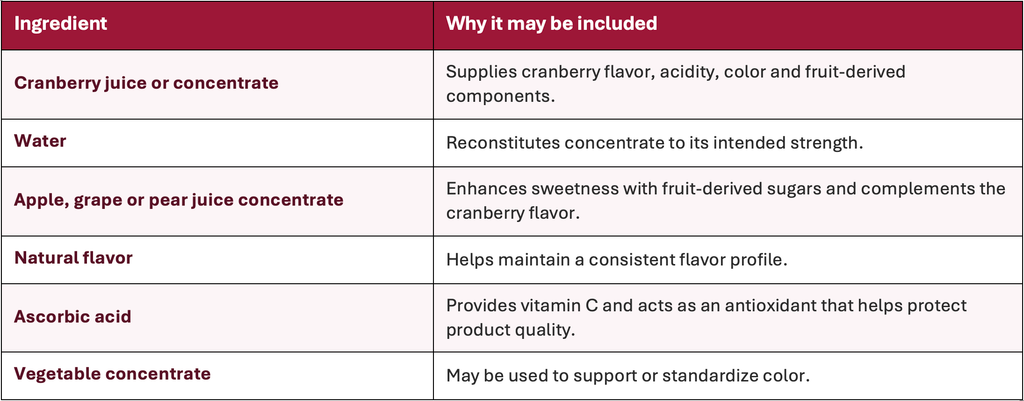
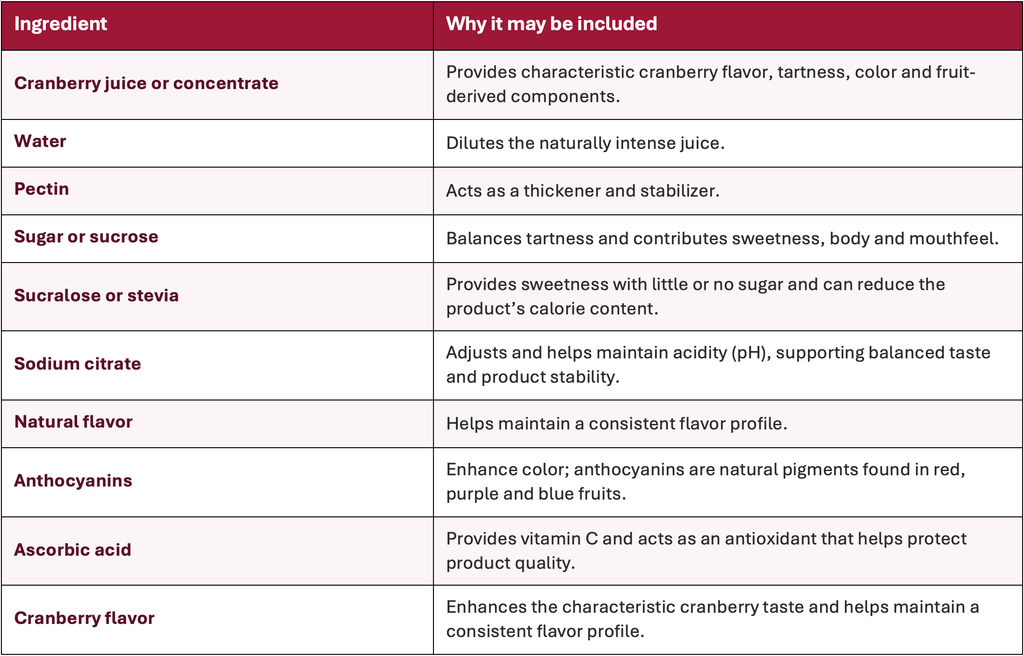
Cranberry juice drink or cranberry cocktail
A cranberry juice drink or cocktail contains cranberry juice together with water and other ingredients. The percentage of juice can vary considerably between products and markets.
These formulations help make intensely tart cranberry juice more palatable and affordable while providing different choices for sweetness, calories and taste.
SAFETY IN CONTEXT
Sweeteners and preservatives
Are non-sugar sweeteners safe?
Non-sugar sweeteners such as sucralose, acesulfame potassium and steviol glycosides must undergo rigorous safety assessment before being authorized for use. These assessments consider population groups including children and, where appropriate, establish an Acceptable Daily Intake (ADI)—the amount that can be consumed every day over a lifetime without an appreciable health risk.
Because these sweeteners are many times sweeter than sugar, only small amounts are generally needed in products such as dried cranberries and cranberry beverages. When used within legally permitted levels, they are considered safe.
Learn more about sweeteners from the European Food Safety Authority (EFSA).
Understanding preservatives
Preservatives help keep foods safe and maintain their quality by slowing undesirable microbial growth or chemical changes such as oxidation. They can extend shelf life, preserve taste, color and nutritional quality, and help reduce food waste. Preservatives used in foods must undergo safety evaluation and be permitted for their intended uses.
Learn more about preservatives from the International Food Information Council (IFIC).
EIGHT QUICK CHECKS
How to read a cranberry product label
- Product name: Is it frozen fruit, dried fruit, sauce, 100% cranberry juice, a 100% juice blend or a juice drink?
- Ingredient order: Ingredients are generally listed in descending order by weight.
- Percentage of juice: A cranberry drink may contain considerably less cranberry juice than a 100% juice product.
- Total and added sugars: Total sugars include naturally occurring and added sugars. Where declared, added sugars show how much was introduced during formulation.
- Type of sweetener: Sugar, HFCS, juice concentrate and non-sugar sweeteners perform different formulation roles, but overall sugar and calories are more informative than focusing on one ingredient alone.
- Serving size: Compare products per 100 g, per 100 ml or using equivalent serving sizes.
- Special sensitivities: People with allergies or sensitivities should always read the ingredient and allergen information.
- Local formulation: Ingredients and labeling requirements can vary between countries and even between versions of the same brand.
MATCH THE FORM TO THE USE
Choosing the right cranberry product
- Unsweetened frozen cranberries: Healthy version for cooking, baking, sauces and smoothies when you want to control the amount and type of sweetener.
- Dried cranberries: In measured portions to add fruit flavor, color and texture to oats, salads, grain dishes, trail mixes and baked goods.
- Cranberry sauce: As a condiment, while considering its serving size and added-sugar content.
- 100% cranberry juice: When you want an intensely tart healthy juice with no separately added sweetener.
- 100% juice blend: For a naturally sweeter taste, remembering that it can still contain considerable naturally occurring sugar.
- Cranberry juice drink: Compare the juice percentage, added sugars, type of sweetener, calories and serving size.
The bottom line
Processing gives cranberries different flavors, textures, shelf lives and culinary uses. Some products contain only cranberries, while others include sweeteners, oils, glycerin, acidity regulators, stabilizers or preservatives for specific technological reasons.
Ingredients such as HFCS, permitted non-sugar sweeteners and approved preservatives are not inherently unsafe when used in accordance with applicable food regulations. At the same time, regulatory safety and nutritional composition are different considerations. Consumers should still look at added sugars, calories, juice content, serving size and the overall role of the product in their diet.
